

Flat Fee vs. AUM Fees: When 1% Starts Costing You Millions
Most financial advisors charge around 1% of your assets per year. That may not sound like much… until you run the numbers. In this article, we’ll compare a few examples below:
Traditional AUM (Assets Under Management) fees
Flat Fee model
And how the difference can impact your wealth over 20 years
The Fee Structures We’re Comparing
AUM Model (Industry Standard)
1% annually
Increases with your portfolio
Flat Fee Model (Example Structure)
Under $2.5M → $500/month ($6,000/year)
$2.5M–$5M → $1,000/month ($12,000/year)
$5M+ → $2,000/month ($24,000/year)
Scenario Assumptions
Annual return: 8%
Time horizon: 20 years
Fees deducted annually
No additional contributions
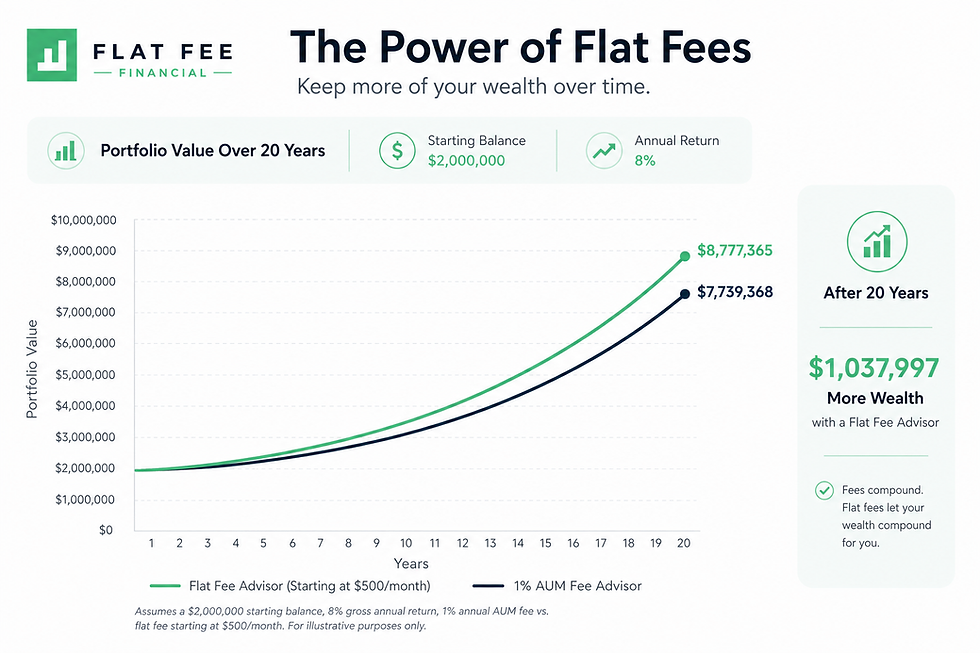
$2 Million Portfolio Example
Annual Fees
AUM (1%): $20,000/year (starting point), $72,330/year (ending point)
Flat Fee: $6,000/year (starting point), $24,000/year (ending point)
20-Year Outcome
Model | Total Fees Paid | Ending Portfolio Value |
AUM (1%) | $819,909 | $7,739,368 |
Flat Fee | $288,000 | $8,777,365 |
Difference in wealth: $1,037,997
What’s Really Happening Here?
This isn’t just about paying higher fees.
It’s about compounding working against you.
Every dollar paid in AUM fees:
Leaves your account
Stops compounding
And reduces your future returns
Meanwhile, flat fees:
Stay fixed
Become a smaller % of your portfolio as it grows
Allow more of your money to stay invested and compound over time
The Break-Even Point
Around $1M in Investable Assets:
Costs between a 1% AUM model and a flat fee model begin to diverge meaningfully
$2M+:
Flat fees often create hundreds of thousands in savings
$5M+:
The difference in your ending portfolio value can reach $1M–$2M+ over time
When AUM Might Still Make Sense
To be fair, AUM can work if:
Your portfolio is under $600K
You value behavioral coaching tied to market performance
But at higher asset levels, the key question becomes:
Is the advisor charging 1% of assets under management, providing more value than the flat fee advisor? This answer is always it depends but I believe it would be difficult.
The Bottom Line
A 1% fee sounds small, but over time, it can add up to a 7-figure number
Once you cross $2M, the math often shifts heavily in favor of flat fees
Over 20 years, the difference isn’t just noticeable, it can be life-changing
Conclusion
Most advisors I know will see high-fee investment funds and recommend transitioning to a lower-cost option, such as Vanguard or iShares. Because you're receiving a similar service for a lower fee. Even if they are striving for a little alpha through factor investing, the factor fund fees are slightly higher, up from .07% to .18%. But often, they stop the fee compression discussions there. In reality, there are extremely similar financial planning services that clients could receive for a potentially much lower fee, depending on the assets under management.


